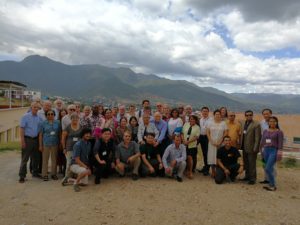
INDR LAMENTS THE PASSING OF
PROFESSOR LAKSHMAN KUMAR MAHAPATRA
29 OCTOBER 1929 — 1 JUNE 2020
 The International Network on Displacement and Resettlement (INDR) deeply laments the passing of our colleague Professor Lakshman Kumar Mahapatra.
Michael Cernea, former World Bank Senior Advisor on Development and Social Policies, recognizes Mahapatra
“as a leading Indian militant Social Anthropologist and a vastly influential scholar, both in India and far beyond. He was also a dear personal friend, whom I much respected. I was fortunate to meet him several times, both in scientific conferences, and when I visited him twice in Bhubaneshwar, Orissa. We also kept a long transoceanic correspondence which also enriched our same wavelength ness. I also cherished Lakshman’s writings, his insightful theoretical papers, and his Reports based on his own empirical research. The major Mahapatra Address: “DEVELOPMENT FOR WHOM?”, presented decades ago at the Vancouver International Anthropological Conference, was a searing critique of India’s Governments, as well as of Governments elsewhere, for their misguided policies and practices of forcibly displacing and impoverishing countless people. It was also an open question and a powerful call to the international community of Anthropologists and Sociologists to battle for defending the livelihood, the culture, and the dignity of India’s large tribal populations. Lakshman Mahapatra’s seminal book RESETTLEMENT, IMPOVERISHMENT, AND RECONSTRUCTION IN INDIA (1999) has inspired me, and I am sure it will continue to inspire many, many other scholars.”
Another INDR Founder and a leading resettlement scholar, Thayer Scudder, called Mahapatra “my partner in crime“, adding
“L K. Mahapatra was my favorite Indian colleague. It was he who arranged for me to be picked up at midnight in Ahmedabad by a motorcycle to visit the office of the NGO which might give us their data that documented that there was sufficient enough land for initial resettlement purposes. To convince them, l also had to return by motorcycle the next night. Later they slipped the necessary data under my hotel door the next night.
After I returned to Delhi; this data enabled me to show national irrigation authorities in Delhi about the availability of land for proper resettlement through the Chief Engineer, Sardar Sarovar Project had insisted that there was insufficient land for proper population resettlement. Alas, we never had the chance to meet socially and develop a close personal friendship.“
INDR offers further honors and tributes to Mahapatra from Bishnupada Sethi, Triloki Nath Pandey, Robert Parkin and Akio Tanabe. We all recommend honoring a fitting overview of his amazing life, work and gallery.
On behalf of those displaced and the vulnerable, whom he fought and cared for, but who may have never known him, INDR offers eternal thanks.
Theodore E. Downing, President INDR
2020 MEETING POSTPONED DUE TO CONVID-19
20th Anniversary of INDR to be held in Hyderabad in 2021
The meeting will be hosted by the Administrative Staff College of India (ASCI). Date to be announced.
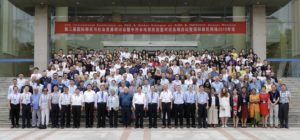
The International Network on Displacement and Resettlement (INDR), Hohai University and 9 Collaborating Organizations held a large, productive meeting and workshops at is 2019 GLOBAL CONFERENCE on Benefit-Sharing in Displacement and Resettlement (31 Aug – Sept 3, Hohai University in Nanjing). The meeting took place in collabration with a Pre-Conference Study Tours on Resettlement at the Three Gorges Project and a review of Nanjing Urban Resettlement. Over 122 papers were presented in over 40 sessions with attendance reaching over 300.
From 31 August to Sept 3, Program C0-Chairs SHI Guoquig (NRCR Hohai University) and Theodore Downing (President, INDR) collaborative work with scholars, practitioners, and specialists on a core issue in resettlement: benefit-sharing and sustainable development as a major way to improve the lives and livelihoods of those displaced or resettled. Benefit-sharing issue touches every dimension of resettlement, from planning, financing, operations, evaluation, and more. In the near future, the final program and abstracts will be posted on this site. The review the program announcement for details,
Call for Expression of Interest in a Special Issue
Impact Assessment and Project Appraisal on
Benefit-Sharing in Displacement, Resettlement and Rehabilitation
This is a call for an expression of interest in contributions to a new Special Issue of Impact Assessment and Project Appraisal (IAPA) focusing on benefit-sharing in displacement, resettlement and rehabilitation in development-induced displacement and resettlement. INDR members have extensive experience in benefit-sharing, increasing with sustainable development and directly sharing in the returns from infrastructure improvements. Contributions to the proposed edition are expected to be selected from papers and/or presentations in the 2nd International Conference on Resettlement and Development’ August 31-September3 2019 in Nanjing and those responding to this call for interests (see details).
INDR Comments on UNEMG Draft Common Approach to Environmental and Social Standards for UN Programming

An INDR Ad Hoc Committee critically commented on the UN Environmental Management Group’s (UNEMG) draft Common Approach to Environmental and Social Standards for UN Programming (aka the “Model Approach”).
The UNEMG claims its Model Approach will strengthen the sustainability and accountability of UN entity programming and…improve policy coherence and collaboration. Unfortunately, rather than develop and implement a binding, mandatory, overarching policy framework, their used the “benchmark standards” to which UN agencies may or may not voluntarily align themselves. The Model’s Benchmark Standard 5 on Displacement and Involuntary Resettlement appears to have largely borrowed obsolete, boilerplate provisions and language from existing, weakened performance standards, such as those of the World Bank. The INDR Ad Hoc Committee found the current draft Model Approach undermines its very own objectives to “strengthen the sustainability and accountability of UN entity programming and…improve policy coherence and collaboration.” Read their findings at Here.”
INDR 2019 Preliminary Meeting Announcement
 The International Network on Displacement and Resettlement is pleased to announce that its 2019 meeting will be held in China from 30 August to September 3 in Nanjing City. Professors Theodore Downing and SHI Guoqing will Co-Chair. The Sponsors include INDR, Hohai University, the China Three Gorges Group Co. Ltd, Three Gorges University, among others. Participants may join a week-long, post-conference study tour.
Communications regarding this meeting will be sent to INDR19@displacement.net Deadlines for participants will follow.
INDR Specialists from 15 countries conducted 14 Intensive Workshop in Oaxaca, Mexico 13-15 August, 2018.
 INDR forced displacement specialists completed the first of a series of three international meetings to consider a new evidence-based, forced displacement standard for forced displacement and resettlement. 54 specialists conducted and participated in 14 workshops/roundtables. The meetings took place from 13-15 August 2018 in Oaxaca, Mexico. The Centro de Investigaciones y Estudios Superiores en Antropología Social (CIESAS), one of Mexico’s top anthropological research center, co-hosted with Salomon Nahmad-Sitton as Local Arrangements Chair. President Theodore (Ted) Downing with the assistance of Program Chairman Mohammad Zaman and indigenous affairs specialist Ramon Martinez instituted what Ted called a “high speed workshop format” permitting intensive, full participation of attendees. Fueled by exquisite Oaxaca cuisine, INDR solidarity was demonstrated by all the participants dancing in the streets! Preliminary plans for the 2019 INDR meetings in China are underway. Possible Swedish and other meetings await the scholars/specialists/dancers. Contact INDR19 for details.
The INDR 2018 Program and Abstracts merits review.
An INDR Analysis: The World Bank Guidance Notes on Involuntary Resettlement Miss the Mark
 The World Bank solicited comments on its proposed Guidance Notes (GN) to their new Environmental and Social Standard Standard No. 5 (ESS5). An INDR team of involuntary resettlement specialists found the draft GN fell short of the policy’s overall objectives. Specifically, the notes
- omit or fail to provide guidance regarding certain core elements of the ESS5 that are key to achieving borrower compliance with the requirements and, therefore, satisfactory involuntary resettlement.
- does not reflect accurately many lessons learned over several decades of international experience with involuntary resettlement.
- key technical, social and economic analyses essential for sound project design are missing including asymmetrical power relationships that vitiate mandated consultations with affected people.
Moreover, operational guidance on classifying, managing, monitoring and evaluation for involuntary resettlement risks and outcomes specifically could be strengthened significantly to address the priorities highlighted in the overall Environmental and Social Framework. And, in contrast to previous Bank policies, resettlement expertise, experience, and specialization is excluded from project preparation, appraisal, and implementation in contrast to the previous Bank policy on resettlement.
The detailed INDR Commentary explains these shortcoming.
INDR Scientists Will Not Meet in the USA – Acting against unreasonable travel restrictions

Immigration entry stamp on the inside page of a passport.
Due to unreasonable restrictions on travel and visas imposed by the current United States administration, the International Network on Displacement and Resettlement (INDR) has suspended holding its scientific meetings in the USA. INDR is composed of internationally recognized specialists on forced population displacement and resettlement in many countries, some of which are arbitrarily banned from entering the USA. The scapegoating of innocent citizens of certain countries together with the abusive discrimination against international refugees and migrants violate our ethics and professional responsibility to the displaced communities with whom we work. Until such time as the USA respects the dignity, integrity, and worth of victims of physical, economic, or political displacement together with their right to resettlement the scientific meetings of the INDR will not be held in that country.
RESCHEDULED 16-29 April 2018 –
CHINA’s NRCR OFFERS UNIQUE WORKSHOP AND TRAINING OPPORTUNITY
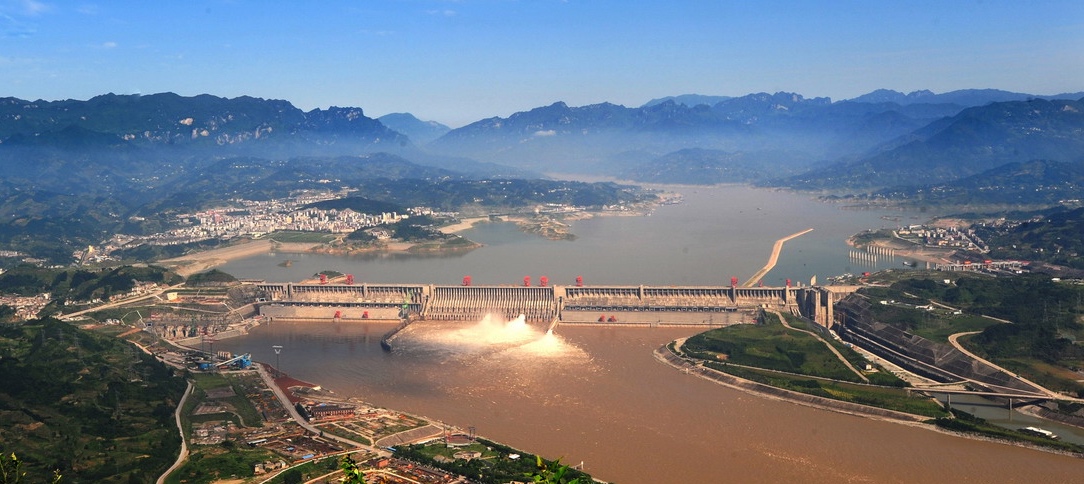 The National Research Center for Resettlement (NRCR) at Nanjing, China has announced its International Training Workshop on Management of Land Acquisition, Resettlement and Rehabilitation (MLARR) to be held 16-29 April 2018 (dates are incorrect on program documents). We are pleased to share this exciting workshop, which includes a five day Three Gorges Study Tour. Review registration information and contact Dr. Yi Li, yili@hhu.edu.cn, +86 25 83718914 (fax) .
Are Indonesia’s Country Standards equivalent to the Asian Development Bank’s Involuntary Resettlement Standards? A Report of an INDR Ad Hoc Commission on Country Standards.
The 2017 Annual meeting focused on the international financial intermediaries (IFI) focus on using country rather than international standards for development project related forced displacement. The process will require comparing country standards to international standards. The process is just beginning.
An Asian Development Bank (ADB) technical paper argued that Indonesia’s Country Safeguard System (CSS) for involuntary resettlement meets its Safeguard Policy Statement (2009) for measures of both “equivalence” and “acceptability”. It found Indonesian laws, regulations and procedures were “broadly aligned with the objectives, scope and triggers” of ADB safeguards. An Ad Hoc Commission of the International Network on Displacement and Resettlement (INDR) has completed a detailed review. INDR disagrees with the ABD findings, concluding that Indonesia does not yet satisfy either the equivalence or the acceptability standards.
The INDR Commission discovered key issues that will face any attempt to “graduate” a country as providing equivalent or acceptable standards.
11 Successful Scientific Sessions at the 2017 Annual Meeting of the INDR in Santa Fe
Program Chair Juan Xi again organized an exceptional sessions to address key questions about forced displacement of peoples by development.
REVISED 22 Mar 2017
Program of the 2017 Annual Meeting[1]
International Network for Displacement and Resettlement (INDR)
Dr. JUAN XI (U of Akron), Program Chair
Santa Fe, New Mexico – Inn at Loretto – Tesuque Ballroom
Wednesday 29 MARCH
Theme 1. Can International Policies Change Country Laws, Policies, Practices and institutions to Improve the Plight of Those Displaced by Development?
In search of a Country Safeguard: Reconceptualising resettlement roles and mandates at international and national levels. 8:00-9:50
Chair: PRICE, Susanna (Australian Nat’l U)
- BERGMAN, Michaela (EBRD) Why Does an International Lender Not Use Country Safeguards for Resettlement and Other Social Safeguards?
- TAGLIARINO, Nicholas (U Groningen) How Do National Laws on Land Acquisition Compare with International Policy Standards?
- Schmidt-Soltau, Kai (IRS) Quo vadis safeguards? Past, Present & Prospects of the precautionary approach in development.
- Downing, Theodore (INDR) and Garcia-Downing, Carmen (U Arizona) Doubling Down and Losing (Again): Will Replacing International Safeguard Standards with Country Safeguard Systems Improve the Plight of those Displaced by Development?
Theme 1. Can International Policies Change Country Laws, Policies, Practices and institutions to Improve the Plight of Those Displaced by Development?
Latin America: Rights, Responsibilities and Results 10:00-11:00
Chair: Downing, Theodore (INDR), and Garcia-Downing, Carmen (U Arizona)
- SIMON, Jeanne W. and GONZALEZ-PARRA, Claudio (U Concepcion) Hydroelectric Dam Construction and Involuntary Displacement and Resettlement of Pehuenche Families: Cultural and Political Transformations in the Biobio Highlands 20 Years Later
- OLIVER-SMITH, Anthony (UF) Resettlement for Disaster Risk Reduction in Latin America
Theme 1: Roundtable and Open Forum on Mining and Displacement (1/2 session) 11:00-11:50
Hedda Ashland, Sabine Luning, Rebekah Ramsay, Susanna Price and Ted Downing
LUNCH BREAK 11:50-1:30
Theme 1. Can International Policies Change Country Laws, Policies, Practices and institutions to Improve the Plight of Those Displaced by Development?
Policies vs laws and their articulation in communities – 1:30-3:20
CHAIR: BERGMAN, Michaela (EBRD)
- RHOADS, Russell (GVSU) Would a National Resettlement Policy Help Protect Community Lands in Uganda?
- PILLAI, Sam (Independent) What Does It Take to Mandate Good National Policy into Law? The Case of Sri Lanka’s National Involuntary Resettlement Policy
- LUNING, Sabine (Leiden U) Characteristics of Mining Projects: Shifting Values in Negotiations over Access to Land and Water in Burkina Faso.
- SEK SOPHORN (Social Safeguard /Legal Specialist) International policies, national laws on resettlement and indigenous peoples and their articulation in Cambodian communities.
Re-thinking the Notion of Resettlement and Resettlement Practitioners 3:30-5:20
CHAIRS: DOWNING, Theodore (INDR), and GARCIA DOWNING, Carmen (U Arizona)
- PRICE, Susanna (Australian Nat’l U) Searching for a Safeguard: What opportunities and what new obstacles will be faced by people in the way of the Realigned Development Arrangements
- KATIN, Nicole (Tulane U) The Invisible Displaced: The Human Costs of Conservation in Serra do Mar State Park, Brazil.
- DENNIS, AARON (Consultant) Discussant
THURSDAY 30 MARCH
Improving the Knowledge and Challenging the Paradigm of Development-Caused Displacement and Resettlement
Part 1: 8:00-9:50
CHAIR: CERNEA, Michael M. (INDR)
- CERNEA, Michael M. (INDR) The Evolution Of, and Challenges To, the Paradigms for Development-Caused Displacement and Resettlement: Constructive Ways of improving Them
- WALICKI, Nadine (IDMC) Mapping Internal Displacement: Towards a Global Picture of the Scale and Impacts of Development-Caused Displacement
- HÄNSCH, Valerie (U Bayreuth) and SAAGE-MAAß, Miriam (ECCHR) Legal Actions as New Forms of Protest and the Call for Accountability: A Legal Case in Germany on Dam Displacements in Sudan
Part II: 10:00-11:50
CHAIR: CERNEA, Michael M. (INDR)
- SHI, Guoqing and SHANG, Kai (Hohai U) Land Securitization Resettlement Mode: A New Mechanism for Benefit Sharing with Resettlers Induced by Hydropower Projects
- SINGER, Jane (Kyoto U) The Centrality of Livelihood and Location in Involuntary Resettlement: Reexamining Indonesia’s Transmigration Scheme
- ALBERTOS, Carmen (IADB) A Novel Policy to Address Legacies of Past Projects: Agreement for Reparations to the Populations Displaced by the Chixoy Dam in Guatemala
- BERGER, Elana (BIC) and NTENGA, Moses (Joy for Children) Boomtown Risks often Accompany Resettlement Risks: Sexual Abuse at the Site of Uganda’s and World Bank’s Transportation Sector Project
LUNCH BREAK 11:50 AM -1:30PM
Part III. 1:30-3:20
CHAIR: CERNEA, Michael M. (INDR)
- DEAR, Chad and STEVENS, Caleb (USAID) Reducing Risks and Safeguarding People amid Complexity, Uncertainty, and Change: New Guidelines for Development-Caused Compulsory Resettlement Adopted by USAID in 2016
- RAJAGOPAL, Balakrishnan (MIT, DRAN) Reflecting on DFDR through the Lens of International and Comparative Human Rights Law: Extraterritoriality, Obligations of Non State Actors, and Reparations
- DISCUSSANT: CERNEA, Michael M. (INDR)
INDR Business and Open Forum for ALL PARTICIPANTS on Forced Displacement and Resettlement 3:30-4:10 BOARD ROOM IN THE DRURY
THE HUMAN RIGHTS APPROACH TO FORCED DISPLACEMENT: DISCUSSION OF A FORTHCOMING THEMES FOR INDR 2018 4:15 – 5:20 BOARD ROOM IN THE DRURY
Open Discussion led by Sam PILLAI and Mohammad ZAMAN
FRIDAY 31 MARCH
Social Impact Assessment (SIA) for Evidence-Based Resettlement Policy Making 8:00-9:50
CHAIR: XI, Juan (U Akron)
- IOANNIDES, Michael and TILT, Bryan (OR State U) Status Update on the Oregon State University Dam Impacts Database
- SMYTH, Edward and VANCLAY, Frank (Groningen U) Discussion of Measures to Protect Vulnerable Groups in Land Acquisition and Resettlement Projects
- CHECK, Kristen (Water Mission) Using Qualitative Methods for Actionable Results in International Development
- SHI, Guoqing, ZHOU, Jian, and ZHANG, Xiaochen (Hohai U) Social Impact Assessment: A Case Study for An Urban Developmental Project.
- ASKLAND, Hedda Haugen (U Newcastle NSW) Displaced in Place: Disrupted Trails and Lost Directions
LUNCH BREAK 11:00 – 12:00
Perspectives and Considerations on Dam-Induced Displacement and Resettlement 12:00-1:20
CHAIR: HAMAMOTO, Atsushi (Nagoya City U)
- HAMAMOTO, Atsushi (Nagoya City U) Mental Anguish and Plundering of Lives: The Adverse Impact of Dam-induced Displacement in Japan
- SUN, Haibing (CTGU) An Analysis of Reservoir Resettlement from the Perspective of Social Welfare.
- ZHANG, Xiaochen, SHI, Guoqing, HUANG, Li, and SUN, Zhonggen (Hohai U) Methodology and Experiences of Social Impact and Risk Assessment for Hydropower Projects in China
- ZHAO, Xu and DUAN, Yuefang, (CTGU) Policy-Induced Poverty of Reservoir-Resettlers from the Perspective of Double Social Changes: Based on the Case of the Late-stage Support for the Three Gorges Rural Resettlers.
THEME II. Improving the Knowledge and Challenging the Paradigm of Development-Caused Displacement and Resettlement
Resettlement Practices in China 1:30-3:20
CHAIR: XI, Juan (U Akron)
- YU, Qingnian (Hohai U) Benefit Sharing in China’s Involuntary Resettlement
- CHEN, Xiaonan and YU, Jin (NWAFU) Voluntary or Involuntary? The Role of Poverty Alleviation Policy in Resettlement Practices in China.
- DUAN, Yuefang and XU, Zhao (CTGU) Urbanization of Resettlers in Water Resources Projects: Characteristics, Challenges and Mechanisms for Innovation.
- WANG, Xubo (Hohai U) Chinese Household Land Contract Responsibility System as a Mechanism of Affection Allocation
- DISCUSSANT: CERNEA, Michael M. (INDR)
[1] The INDR meeting is being held in conjunction with The Society for Applied Anthropology
IN Latest Resettlement News: The Controversy over Safeguard Policies. A Critique by Michael Cernea, Vinod Thomas and Rob van den Berg
Looking back on development-induced forced resettlement in the US
 Development and the public good was the rationale the US President Andrew Jackson (1829-1837), founder of the Democratic Party, gave for forced removal of the Five Civilized tribes from the eastern US in 1830? For the Cherokee peoples, the removal became known as the Trail of Tears. By 1837. 46,000 Indians from the southeastern states had been removed from their homelands, thereby opening 25 million acres (100,000 km2) for predominantly white settlement. History records 3,500 Creeks, 2,500 to 6000 Choctaws, and approximately 2,000-6,000 of the 16,543 relocated Cherokee perished along the way.
We share a transcript of President Jackson’s hand written, justification we found in The National Archives. The relocation, he argues, was in the public interest with a land for land policy.
Ted Downing
www.TedDowning.com
Transcript of President Andrew Jackson’s Annual Message to Congress “On Indian Removal” 1830
“It gives me pleasure to announce to Congress that the benevolent policy of the Government, steadily pursued for nearly thirty years, in relation to the removal of the Indians beyond the white settlements is approaching to a happy consummation. Two important tribes have accepted the provision made for their removal at the last session of Congress, and it is believed that their example will induce the remaining tribes also to seek the same obvious advantages.
The consequences of a speedy removal will be important to the United States, to individual States, and to the Indians themselves. The pecuniary advantages which it promises to the Government are the least of its recommendations. It puts an end to all possible danger of collision between the authorities of the General and State Governments on account of the Indians. It will place a dense and civilized population in large tracts of country now occupied by a few savage hunters. By opening the whole territory between Tennessee on the north and Louisiana on the south to the settlement of the whites it will incalculably strengthen the southwestern frontier and render the adjacent States strong enough to repel future invasions without remote aid. It will relieve the whole State of Mississippi and the western part of Alabama of Indian occupancy, and enable those States to advance rapidly in population, wealth, and power. It will separate the Indians from immediate contact with settlements of whites; free them from the power of the States; enable them to pursue happiness in their own way and under their own rude institutions; will retard the progress of decay, which is lessening their numbers, and perhaps cause them gradually, under the protection of the Government and through the influence of good counsels, to cast off their savage habits and become an interesting, civilized, and Christian community.
What good man would prefer a country covered with forests and ranged by a few thousand savages to our extensive Republic, studded with cities, towns, and prosperous farms embellished with all the improvements which art can devise or industry execute, occupied by more than 12,000,000 happy people, and filled with all the blessings of liberty, civilization and religion?
The present policy of the Government is but a continuation of the same progressive change by a milder process. The tribes which occupied the countries now constituting the Eastern States were annihilated or have melted away to make room for the whites. The waves of population and civilization are rolling to the westward, and we now propose to acquire the countries occupied by the red men of the South and West by a fair exchange, and, at the expense of the United States, to send them to land where their existence may be prolonged and perhaps made perpetual. Doubtless it will be painful to leave the graves of their fathers; but what do they more than our ancestors did or than our children are now doing? To better their condition in an unknown land our forefathers left all that was dear in earthly objects. Our children by thousands yearly leave the land of their birth to seek new homes in distant regions. Does Humanity weep at these painful separations from everything, animate and inanimate, with which the young heart has become entwined? Far from it. It is rather a source of joy that our country affords scope where our young population may range unconstrained in body or in mind, developing the power and facilities of man in their highest perfection. These remove hundreds and almost thousands of miles at their own expense, purchase the lands they occupy, and support themselves at their new homes from the moment of their arrival. Can it be cruel in this Government when, by events which it can not control, the Indian is made discontented in his ancient home to purchase his lands, to give him a new and extensive territory, to pay the expense of his removal, and support him a year in his new abode? How many thousands of our own people would gladly embrace the opportunity of removing to the West on such conditions! If the offers made to the Indians were extended to them, they would be hailed with gratitude and joy.
And is it supposed that the wandering savage has a stronger attachment to his home than the settled, civilized Christian? Is it more afflicting to him to leave the graves of his fathers than it is to our brothers and children? Rightly considered, the policy of the General Government toward the red man is not only liberal, but generous. He is unwilling to submit to the laws of the States and mingle with their population. To save him from this alternative, or perhaps utter annihilation, the General Government kindly offers him a new home, and proposes to pay the whole expense of his removal and settlement.”
Thayer Scudder’s New Book
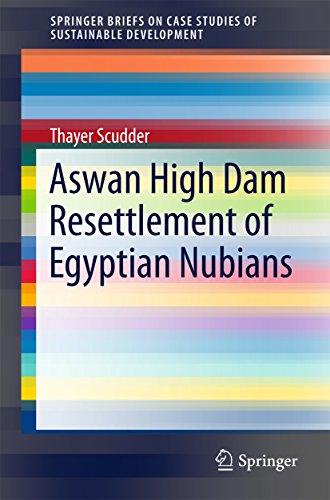
I am delighted to announce that INDR Co-Founder, Thayer Scudder’s new book, Aswan High Dam Resettlement of Egyptian Nubians (SpringerBriefs on Case Studies of Sustainable Development) was just published, including availability in a Kindle edition. His book highlights the long-term resettlement process of the Egyptian Nubian people. Assessing the resettlement of 48,000 Egyptian Nubians in connection with the High Dam is especially important. This resettlement process is one of the rare cases in which research begun before the dam was built has continued for over fifty years. The resettlement of the Egyptian Nubian people is one of the few cases in which the living standards of the large majority improved because of the initial political will of the government, combined with Nubian initiatives. And, given the complexity of the resettlement process, weaknesses in government planning, implementation, and in the weakening of government political will, provide valuable lessons for future dam-induced resettlement efforts. – Ted Downing, INDR President.
Forced Displacement Professionals convene 14 Scientific Sessions at Vancouver INDR Annual Meeting
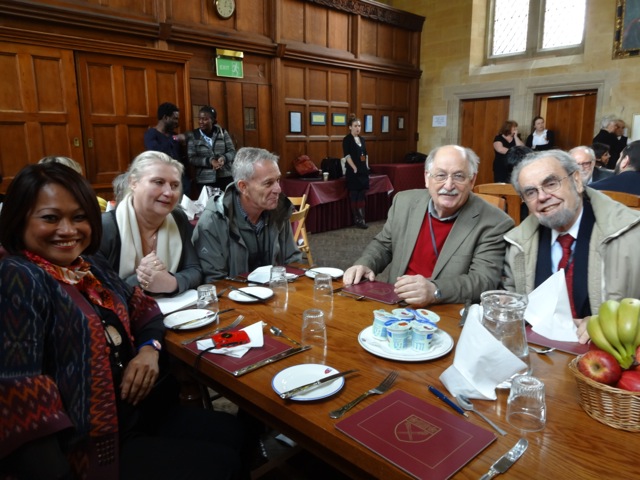
L to R – Susan Tamondong, Inga-Lill Aronsson, Chris deWet, Ted Downing, and Michael Cernea at Oxford
The International Network on Displacement and Resettlement’s Program Chair, Prof. Juan Xi (U of Akron) organized an exceptional scientific sessions. The March 24 – 2 April, 2016 meeting took place in Vancouver in conjunction with the Society for Applied Anthropology (. The INDR program chair, Juan Xi (U. of Akron) organized 14 extraordinary intellectually stimulating sessions discussing topics including reservoir resettlement, mining related resettlement, environment/climate change related resettlement, urban resettlement. Many of the sessions focused on China has the largest number of development projects and has produced the largest number of re-settlers. Myths persists from earlier eras of Chinese forced displacements that do not reflect the new, innovative Chinese resettlement policies and practice. Not only do they confirm that comparable issues reoccur in involuntary resettlement in different countries and projects, they also reveal unique national and local challenges. Key sessions also focused on theoretical and methodological development for re-settlement research. Review the 2016 INDR Program Vancouver 29 Mar to 2 April 2016.
Global experts on Involuntary Resettlement critically review proposed Bank policy changes
The International Network on Displacement and Resettlement (INDR) convened 12 well-attended scientific sessions at its annual meeting at the 75th Annual Society for Applied Anthropology meeting in Pittsburgh in March 2015 (see program and abstracts ). Scholarly debate focused on The World Bank’s proposal to downgrade its existing safeguard policies to, what consensus held, was a lowering of current international standards on involuntary resettlement and on indigenous populations. Anthropologists, sociologists, and environmentalists were the proponents and writers of these policies in the late 1970s and 1980s which have been replicated and adopted much beyond the World Bank itself by all public regional development banks (ADB, AFDB, IDB, EBRD), by over 80 private sector transnational investment-finance banks (the “Equator Principles” banks), by all bilateral aid agencies and export credit agencies of OECD countries, and some national governments. Bank’s Management made an early commitment in 2012 to revise and update, but not dilute existing policies. The consensus of the participants was the update needs significant redrafting to avoid a policy framework that licenses Bank financing to unnecessarily creating new poverty and social risks.
The World Bank President Kim Unexpectedly Acknowledges Shortcomings in Resettlement Projects, Announces Action Plan to Fix Problems (WB Press Release – unedited)
March 4, 2015
Three reports, which reviewed over two decades of World Bank projects involving possible resettlements, found that oversight of those projects often had poor or no documentation, lacked follow through to ensure that protection measures were implemented, and some projects were not sufficiently identified as high-risk for populations living in the vicinity.
“We took a hard look at ourselves on resettlement and what we found caused me deep concern,” said World Bank Group President Jim Yong Kim. “We found several major problems. One is that we haven’t done a good enough job in overseeing projects involving resettlement; two, we haven’t implemented those plans well enough; and three, we haven’t put in place strong tracking systems to make sure that our policies were being followed. We must and will do better.”
The action plan released Wednesday proposes to strengthen systems, staffing, and policy implementation. The plan focuses on improving preparation, supervision and implementation of resettlement, given the disruptive impact it can have on the lives of the people.
The plan is aligned with the World Bank’s ongoing safeguards review process, and is largely based on recommendations from three reports: a 2014 Internal Audit Department (IAD) Advisory Review of the Bank’s Environmental and Social Risk Management; and two internal draft working papers – Involuntary Resettlement Portfolio Review Phase l and Phase ll.
Since late 2012, the World Bank has been consulting with stakeholders on strengthening its environmental and social safeguard policies, including its policies regarding land acquisition and resettlement. On March 1, the World Bank concluded the second phase of consultations on the proposed Environmental and Social Framework, which would strengthen, update and clarify our existing safeguard policies.
On resettlement, World Bank operational teams are already implementing many of the measures identified in the action plan released today, including a comprehensive review of its current policies, additional staff guidance, a systematic risk management framework, and strengthened accreditation of specialist staff.
The plan also includes the use of a new Tracking Social Performance (TSP) Database, in response to a weakness found in two of the reviews that information on the scale and scope of project impacts is difficult to obtain in World Bank systems. This database was developed to better track resettlement issues for all Bank-funded projects with involuntary resettlement, and enable resettlement reports to be generated in real time. A similar tracking system is also now in place for environmental issues.
“Our policy is that if we resettle someone from their home, we will assist efforts to improve, or at least to restore, their incomes and living standards,” Kim said. “Strong policies like ours require strong execution and it requires properly funding reviews and empowering those who work on safeguards. That will change with our action plan.”
More information, including a fact sheet, and an FAQ on the World Bank’s Involuntary Resettlement Policy, is also available.
What is involuntary resettlement?
Involuntary Resettlement refers to two distinct but related processes. Displacement is a process by which development projects cause people to lose land or other assets, or access to resources. This may result in physical dislocation, loss of income, or other adverse impacts. Resettlement or rehabilitation is a process by which those adversely affected are assisted in their efforts to improve, or at least to restore, their incomes and living standards.

The World Bank rejects meeting with Global involuntary resettlement technical experts and their professional association*
* Update. In light of the 4 March release of Bank wide and a sample survey showing serious problems in the Bank’s tracking and execution of it involuntary resettlement policies – information that was NOT shared with either the World Bank’s Board or the commentators on the proposed new Environmental and Social Framework’s Involuntary Resettlement Standards (ESS7) – INDR is appealing the earlier rejection. INDR is offering President Kim and Senior Bank Management assistance from its international experts.
The International Network on Displacement and Resettlement requested a specific, technical consultation(s) on the proposed changes to its involuntary resettlement policies (response below)
From: “Downing, Theodore E – (downing)” <downing@email.arizona.edu>
To: “mking3@worldbank.org” <mking3@worldbank.org>
Cc: Hang Thi Thu Doan <hdoan@worldbank.org>, “hschafer@worldbank.org” <hschafer@worldbank.org>
Subject: Re: 2014/15 Consultation on the Review and Update of the World Bank’s Environmental and Social Safeguard Policies: Invitation to an Expert Focus Group on “Managing Social Risk” – The proposed Environmental and Social Framework
Date: February 13, 2015 at 12:37:09 PM MST
Greetings Mark King,
Thank you for inviting me, as President of the International Network on Displacement and Resettlement (INDR www.displacement.net), to attend the workshop on the draft Environmental and Social Framework on February 18. The INDR is deeply concerned for the lack of a specific technical consultation on involuntary resettlement (ESS5) with the internationally recognized specialists and their professional association.
Now 15 years old, the INDR is the only global professional association working in development-induced displacement and resettlement (DIDR). Its members include all the pioneer theoreticians and practitioners in this field. They have helped develop laws and policies, design, appraise, supervise, monitor, research and develop the leading theories on the resettlement effect. Some have over 30 years of experience with the World Bank and its sister financial intermediaries, with experience in more than 100 member countries of the World Bank in Africa, Latin America, the Middle East, East Asia and South Asia.
At the 2014 Annual Meeting’s safeguards forum, following my testimony, you committed to work with our Network on involuntary resettlement, which your team has recognized as a difficult component in the ESS elements. We welcome the challenge to find ways to avoid and mitigate the multifaceted, impoverishment risks unleashed by forced displacement. Development that creates new poverty is not development – a fundamental contradiction to the Bank’s purpose. This contradiction begins to be resolved by resettlements being treated as development projects in their own right and benefits accrue to the affected populations. Toward this end, I am pleased to report that the INDR is convening over 50 international experts for four days to specifically analyze the proposed ESS5 involuntary resettlement policy next month.
The proposed forum on the 18th of February is too broad and unfocused to permit meaningful, expert consultations on over three dozen technical areas that need attention. These include setting of objectives, planning, timing, meaningful participation of affected people and informed choices regarding settlement locations, livelihood and socio-cultural impacts, compensation, income restoration and improvement, policy consistency, integration of hosts and the resettled, grievances, human rights violation risks, vulnerable groups, accountability of various agencies involved, benefit-sharing, impoverishment avoidance, monitoring and evaluation. Nor would a follow up of written comments offer your team a chance to work through possible solutions with the key global experts in this field.
INDR’s participation in the 18 February meeting might be misinterpreted as a meaningful, technical consultation on involuntary resettlement. For that reason, I will delay my Washington trip until we have scheduled the long overdue consultation specifically on involuntary resettlement with Bank senior management, drawing upon the findings of our March scientific forum. Would the Bank’s Vice President convene a consultation specifically on involuntary resettlement with eight to ten of the INDR’s key global experts?
Recognizing that this might disrupt the schedule, an alternative might be to set the ESS5 element aside from the overall framework for additional enhancement. Over the past four decades, thousands of staff days have been spent dealing with this issue in so many projects, including multiple, high profile Inspection Panel complaints. A prudent, ounce of delay on this element will save extensive time and Bank resources downstream.
We look forward to mutual cooperation.
Ted Downing
President
The International Network on Displacement and Resettlement
www.displacement.net
cc. Hartwig Schafer
Dr. Kim, President
Vice-President Hartwig Schafer’s Rejection
From: Hartwig Schafer <hschafer@worldbank.org>
To: “ted@teddowning.com” <ted@teddowning.com>
Cc: “Stefan G. Koeberle” <skoeberle@worldbank.org>, Mark Alan King <mking3@worldbank.org>, Anne-Katrin Arnold <aarnold@worldbankgroup.org>, Juri Oka <joka@worldbank.org>
Date: February 19, 2015 at 4:34:54 PM MST
Subject: On resettlement
Dear Ted,
Thank you for your note and your engagement with the World Bank’s review of its safeguard policies. We agree that resettlement is among the core issues of this review. This is why the proposed standard on Land Acquisition, Restrictions on Land Use and Involuntary Resettlement (ESS5) introduces a range of suggestions to improve protections for people that are affected by resettlement in World Bank-financed projects.
As you know, consultations close on March 1. Over the past seven months, we consulted with stakeholders from more than 60 countries in the largest consultation effort the World Bank has ever hosted. We had productive discussions with a wide range of stakeholders on resettlement. Two dedicated consultations on land issues have been held just before the Annual Meetings in Washington, DC and in Berlin on November 13. More than 100 organizations and experts participated in both events, which were widely advertised and open to all experts interested in attending. The Expert Roundtable in Washington resulted in an impressive recommendation document that will be crucial for our revisions of the framework. Resettlement has also been specifically addressed in the context of our consultations with Indigenous Peoples and on non-discrimination.
At this point, I hope that you can submit your comments in writing to us. Comments from your organization would be important when we start revising the proposed framework based on stakeholder feedback as soon as consultations are closed.
Best regards,
Hart
Hartwig Schafer
Vice President
Operations Policy & Country Services
INDR Joins 313 Organizations in Protesting the Attempt to Stop Dilution of The World Bank Safeguards
The International Network on Displacement and Resettlement, a 14 year old professional associations supports a global civil society protest to The World Bank sudden decision to abandon the core principles of its safeguard policies. The statement says:
Civil society statement on World Bank safeguards
We, the undersigned organisations, strongly object to the World Bank’s safeguards draft since it falls far short of the rules needed to protect the environment and respect the rights of affected communities, workers and indigenous peoples. The draft derogates from well-established international standards and would effectively dismantle 30 years of policy evolution, setting a dangerous precedent among national, regional and global actors. The draft represents a massive dilution of current Bank policy that undermines momentum for the upward harmonization of social and environmental standards and their alignment with universal human rights.
By eliminating key protections at a time when it has announced its intentions to expand lending to riskier infrastructure, large dams and mega-project schemes, the Bank fails to recognize that strong safeguards are essential to ensuring that project benefits are fairly shared and that the costs are not borne by the poor and marginalised. Weakening the existing safeguard policies would make the Bank’s goals of ending extreme poverty and promoting shared prosperity impossible to achieve.
We fundamentally reject the way in which the review and update of the safeguard policies has been conducted to date, which has been marked by exclusion and a lack of transparency. Crucially, the revision process has failed to meaningfully incorporate the comprehensive inputs by civil society organisations, independent experts and scholars, indigenous peoples, labour unions, and project-affected communities.
The “Review and Update” exercise was expected to take as its basis the existing World Bank policies, which form the social and environmental contract of the World Bank with the world we live in. Consistent with this contract, this “Review and Update” was expected to incorporate additional and better provisions where needed, to correct or eliminate out-dated or unnecessary elements, and replace them — in a transparent manner — with alternative formulations that are subject to subsequent public discussion. Instead, the existing policy texts were discarded and replaced with entirely different texts with vague resemblance to the existing policies. No opportunity was offered during the first phase for a candid discussion about the fundamental changes that have been incorporated in the draft.
A meaningful process of multi-stakeholder consultation on how to operationalize and effectively implement international standards is urgently needed. This process must take the time that is needed to solicit and build on successful models of safeguards that are predicated upon decades of empirical research about how to ensure that development does no harm. It must be based on the understanding that human rights and sustainability are fundamental components of development, which are essential to achieving the Bank’s goals of eliminating extreme poverty and increase shared prosperity.
A revised set of safeguard policies must, at a minimum, address the flaws in the draft that are set out in the annex to this statement.
Annex
The draft Environmental and Social Framework:
Undermines the rights of Indigenous Peoples. Allowing borrowers to “opt out” of implementing the proposed Indigenous Peoples standard would directly undermine successive and hard-fought battles by indigenous peoples at the national, regional and international levels to have their rights recognized and respected, and thus contradict their rights to self-determination and collective ownership of lands, territories and resources. This would constitute a massive dilution of current World Bank safeguard protections and undermine the credibility of the world’s most prominent development finance institution.
Fails to protect the rights of workers. The proposed labour standard would have almost no impact in protecting the rights of workers because, by excluding third party contractors and civil servants, it would apply to only a small fraction of those who work on Bank-financed projects. In addition—unlike other development institutions—it fails to reference or live up to the ILO conventions and Core Labour Standards that must be the cornerstone of a credible labour policy. By needlessly narrowing who the standard applies to, the World Bank will perpetuate instances of unsafe working conditions, child labour, unpaid wages and denial of freedom of association.
Fails to guarantee critical human rights protections. The draft safeguard policy fails to articulate how it will operationalize its stated commitments to human rights, which must underpin an effective safeguard system. The protection of human rights is necessary to attaining the goals of development. The safeguard policy must explicitly identify how the Bank will adequately identify risks to human rights for activities it intends to support through a robust human rights due diligence process. This is crucial if the Bank is to succeed in its stated goals of eliminating extreme poverty and boosting shared prosperity.
Does not meaningfully address climate change. Despite the Bank’s prominence in warning of the dangers that a warming world poses to development, the draft includes only sporadic mention of climate change. The draft does not ensure that projects are in-line with national climate plans, nor does it have clear requirements for assessing and managing the impacts of climate change on the viability of projects or the resilience of ecosystems or local communities in project areas. At the same time, the draft fails to require assessments of greenhouse gas emissions for all high-emission projects or to take steps to reduce emissions.
Tramples the rights and threatens the welfare of communities subject to forced displacement. The draft eliminates the fundamental development objective of the resettlement policy and the key measures essential to preventing impoverishment and protecting the rights of people uprooted from their homes, lands, productive activities and jobs to make way for Bank projects. The draft allows the Bank to finance projects that entail the physical and economic displacement of communities without first ensuring that there is a reconstruction plan and budget available to ensure adequate compensation, sound physical resettlement, economic recovery and improvement. This would be an unconscionable regression in Bank policy that will result in the large-scale impoverishment of affected people and exacerbate inequality, in flagrant contradiction of the Bank’s mandate and goals. The draft also fails to ensure a transparent accounting at project completion that no displaced people end up worse off than without the Bank project.
Lacks adequate protections to prevent deprivations in childhood. Despite an important new requirement to assess impacts on children among other vulnerable groups, the draft lacks critical requirements to address the unique risks to children. As such, Bank projects could continue to have the potential to employ child labour, resettle children far from educational opportunities, and result in the exploitation or trafficking of children, among other risks. Such negative impacts can result in long-term, irreversible deprivations that cause lifelong damage, preventing children from reaching their full potential while perpetuating the cycle of poverty.
Eliminates protections for forests and forest-dependent peoples. The newly rebranded biodiversity standard establishes a single-minded focus on species biodiversity at the expense of ecological integrity and the local communities dependent on natural resources for their livelihoods and cultural survival. Far from safeguarding forests and other natural habitats, the biodiversity standard permits projects in previous ‘no-go’ areas and provides loopholes for logging, while the standard’s heavy reliance on biodiversity offsetting leaves no natural areas off the table for destructive interventions. The draft must strengthen protections for the natural resources that the majority of people living in extreme poverty depend on.
Leaves out persons with disabilities as a distinct group often differently impacted by projects. While the draft does include persons with disabilities for the first time, it does not guarantee that the unique and differentiated impacts of World Bank projects on persons with disabilities will be assessed. Therefore, it does not provide adequate opportunity for persons with disabilities to proportionately share in project benefits and leaves open the possibility that persons with disabilities could be harmed by World Bank projects. Ultimately, persons with disabilities have unique needs that must be addressed throughout the draft.
Lacks protections for gender and SOGIE. By listing women, girls, sexual orientation, and gender identity and expression (SOGIE) within a string of ‘vulnerable groups’, the draft fails to fully grasp the unique impacts on each of these groups. The next draft must systematically address gender and SOGIE throughout the standards, and add a freestanding mandatory gender and SOGIE standard, which is long overdue. This is necessary to explicitly prevent and proactively address the negative impacts of gender and SOGIE-exclusion from project planning and benefits. It will be impossible to end poverty and boost shared prosperity without explicitly addressing gender and SOGIE issues.
Fails to protect and promote land rights. Despite the growing land-grabbing crisis displacing countless indigenous communities, small farmers, fisher-folk and pastoralists throughout the Global South, the draft fails to incorporate any serious protections to prevent Bank funds from supporting land-grabs. While the Bank pledged that the new safeguards would be informed by the Committee for World Food
Security’s ‘Voluntary Guidelines on Tenure of Land, Forests and Fisheries’, the draft fails to strengthen protection of the land rights of poor and vulnerable groups. Instead, it undermines them in many ways, such as by excluding the application of the land and resettlement standard to projects concerning land titling and land use planning.
Excludes nearly half of the Bank’s portfolio. The narrow application of the proposed safeguards to traditional investment projects would exclude the growing share of Bank lending channelled through other lending instruments, which account for nearly half of Bank lending, increasing the fractured nature of safeguards in the World Bank. This will lead to further weakening of a safeguard system that is already underfunded and lacking in independence, effective supervision and support for borrowers during implementation and genuine monitoring of impacts on the ground.
Abdicates Bank responsibility and riddled with loopholes. While there are positive new elements in the framework, including the recognition of free, prior and informed consent for indigenous peoples and an expanded scope for social assessments, these are undermined by: the clear attempt to institutionalize much greater discretion, loopholes which eliminate procedural protections, and a greater reliance on borrower systems without clear identification of when that option is appropriate or how minimum standards would be assured. At the same time, the draft outsources implementation and monitoring of safeguards to borrowers, which represents an unconscionable abdication of responsibility by the Bank.
Threatens to set off a race to the bottom. Ultimately, the policy proposals not only fail to protect the rights of communities impacted by Bank projects and the ecosystems that underpin sustainable development, they also lower the bar for development finance institutions that look to the World Bank to actually set the standards. The World Bank has fallen far short of its goal of setting a new global standard when it comes to protecting the rights of the poor and the environment. Instead, it risks setting off a race to the bottom that is likely to have negative consequences for social and environmental standards globally. The Bank should rather be focused on ensuring, at a minimum, upward harmonization with the strongest existing safeguards and surpassing these protections in order to deliver sustainable development results for the poorest with a focus on promoting global public goods, rather than competing for market share. The Bank should develop its stewardship role in support of principles of sustainability, human rights standards, international laws and their corresponding obligations.
Endorsing organisations
| Organisation | Country | |
| 1 | ActionAid International | International |
| 2 | Africa Europe Faith and Justice Network (AEFJN) | International |
| 3 | African Biodiversity Network | International |
| 4 | Asociación Interamericana para la Defensa del Ambiente (AIDA) | International |
| 5 | CIVICUS | International |
| 6 | Congregation of Christian Brothers | International |
| 7 | Coordinación Grupo de Financiamiento Climática para América Latina y el Caribe (GFLAC) | International |
| 8 | Coordination Regionale des Usagers des Ressources Naturelles du Bassin du Niger (CRUBN) | International |
| 9 | Indigenous Peoples of Africa Coordinating Committee | International |
| 10 | International Accountability Project | International |
| 11 | International Network on Displacement and Resettlement | International |
| 12 | International Rivers | International |
| 13 | International Trade Union Confederation (ITUC) | International |
| 14 | International Work Group for Indigenous Affairs (IWGIA) | International |
| 15 | Jeunes Volontaires pour l’Environnement | International |
| 16 | NGO Forum on ADB | International |
| 17 | Oxfam | International |
| 18 | Pacific Network on Globalisation | International |
| 19 | World Blind Union | International |
| 20 | World Rural Forum | International |
| 21 | World Wildlife Fund | International |
| 22 | Human Rights House in Albania | Albania |
| 23 | Pink Embassy | Albania |
| 24 | Federation Algerienne des Personnes Handicapées | Algeria |
| 25 | Entidades Representativas de las Personas con Discapacidad de la Republica (ENCIDIS) | Argentina |
| 26 | Foro ciudadano de participación por la justicia y los derechos humanos (FOCO INPADE) | Argentina |
| 27 | Fundación para el Desarrollo de Políticas Sustentables (FUNDEPS) | Argentina |
| 28 | Grito de Alcorta | Argentina |
| 29 | EcoLur | Armenia |
| 30 | Transparency International Anti-Corruption Center | Armenia |
| 31 | Centre for Ecology & Spirituality | Australia |
| 32 | Christian Brothers Oceania Province | Australia |
| 33 | Planet Wheeler Foundation | Australia |
| 34 | EKOMED | Azerbaijan |
| 35 | Oil-Workers’ Rights Protection Organization Public Union | Azerbaijan |
| 36 | Union of Disabled People Organisations | Azerbaijan |
| 37 | Bangladesh Krishok Federation | Bangladesh |
| 38 | Community Development Association (CDA) | Bangladesh |
| 39 | BARNOD-National Organization of the Disabled | Barbados |
| 40 | 11.11.11- Coalition of the Flemish North-South Movement | Belgium |
| 41 | ACV-CSC | Belgium |
| 42 | Centre National de Coopération au Développement, CNCD-11.11.11 | Belgium |
| 43 | DGCD – SPF Affaires étrangères | Belgium |
| 44 | FIAN Belgium | Belgium |
| 45 | KVG | Belgium |
| 46 | Mercy Home | Belgium |
| 47 | Terre et eau ASBL | Belgium |
| 48 | Centro de Estudios para el Desarrollo Laboral y Agrario (CEDLA ) | Bolivia |
| 49 | Instituto Teribre | Brazil |
| 50 | Organisation d’Appui à l’auto Promotion (OAP) | Burundi |
| 51 | Parole et Action pour le Réveil des Consciences et l’Evolution des mentalités (PARCEM) | Burundi |
| 52 | Union des Peuples Autochtones pour le Reveil au Developpement (UPARED) | Burundi |
| 53 | Equitable Cambodia | Cambodia |
| 54 | Global Network for Good Governance (GNGG) | Cameroon |
| 55 | Mbororo Social and Cultural Development Association (MBOSCUDA) | Cameroon |
| 56 | Réseau Camerounais des Organisations des Droiits de l’Homme (RECODH) | Cameroon |
| 57 | Social Justice Connection | Canada |
| 58 | Maison de l’Enfant et de la Femme Pygmées (MEFP) | Central African Republic |
| 59 | Beijing Gender Health Education Institute | China |
| 60 | Green Watershed | China |
| 61 | Greenovation Hub | China |
| 62 | Agrosolidaria Seccional Viani | Colombia |
| 63 | Asociación Ambiente y Sociedad | Colombia |
| 64 | Federacion Accion Campesina Colombiana | Colombia |
| 65 | FUNCOP | Colombia |
| 66 | Fundación Amazonia Sostenible | Colombia |
| 67 | Groupe de Recherche et de Plaidoyer sur les Industries Extractives (GRPIE) | Côte d’Ivoire |
| 68 | Forests of the World | Denmark |
| 69 | LGBT Denmark | Denmark |
| 70 | Action Communautaire pour la Promotion des Défavorisés Batwa (ACPROD-Batwa) | DRC |
| 71 | Action des Chrétiens Activistes des Droits de l’Homme à Shabunda (ACADHOSHA) | DRC |
| 72 | Action Paysanne contre la Faim APCF | DRC |
| 73 | Association des Victimes de Kilwa | DRC |
| 74 | Centre d’Appui à la Gestion Durable des Forêts Tropicales (CAGDFT) | DRC |
| 75 | Centre de Développement Communautaire (CEDECO) | DRC |
| 76 | Cercle pour la défense de l’environnement (CEDEN) | DRC |
| 77 | Coalition Réformes et Actions Publiques (CORAP) | DRC |
| 78 | Conseil régional des Organisations Non Gouvernementales de Développement (CRONGD) | DRC |
| 79 | DRC Debt Coalition | DRC |
| 80 | Dynamique des Groupes des Peuples Autochtones (DGPA) | DRC |
| 81 | Etudes d’Impacts Et des Normes Environnementales (EIENE) | DRC |
| 82 | Foyer de Développement pour l’Autopromotion des Pygmées et Indigènes Défavorisés | DRC |
| 83 | Groupe d’Action pour Sauver l’Homme et son Environnement (GASHE) | DRC |
| 84 | Hope for indigenous peoples (FDAPID) | DRC |
| 85 | Jeunes Associés pour le Développement Intégral (JADI) | DRC |
| 86 | Justice Pour Tous | DRC |
| 87 | Kindu Maendeleo (KM) | DRC |
| 88 | Nouvelles dynamiques pour le developpement rural integral (NODRI) | DRC |
| 89 | Observatoire Gouvernance et Paix (OGP) | DRC |
| 90 | Organisation Congolaise des Ecologistes et Amis de la Nature (OCEAN) | DRC |
| 91 | Réseau CREF | DRC |
| 92 | Reseau Ressources Naturelles | DRC |
| 93 | Centro Andino para la Formación de Líderes Sociales (CAFOLIS) | Ecuador |
| 94 | Centro de Derechos Económicos y Sociales (CDES) | Ecuador |
| 95 | Centro Ecuatoriano de Derecho Ambiental | Ecuador |
| 96 | Federación Nacional de Ecuatorianos de Discapacidad Física (FENEDIF) | Ecuador |
| 97 | ُEgyptian Center for Civil and Legislative Reform | Egypt |
| 98 | Egyptian Center for Economic and Social Rights | Egypt |
| 99 | Egyptian Initiative for Personal Rights | Egypt |
| 100 | Habitat International Coalition – Housing and Land Rights Network | Egypt |
| 101 | Seven Million Disabled | Egypt |
| 102 | Asociación salvadoreña de Transgeneras y Transexuales (ASTRANS) | El Salvador |
| 103 | COMCAVIS Trans | El Salvador |
| 104 | HT503 Generacion Hombres Trans | El Salvador |
| 105 | El Pueblo Indigena Bubi de la Isla de Bioko | Equatorial Guinea |
| 106 | Committee for IDAHO-T International Day Against Homophobia and Transphobia | France |
| 107 | European Rivers Network (ERN) | France |
| 108 | Amis de la Nature-Culture et Environnement | Gabon |
| 109 | Association Gabonaise d’Assistance aux Femmes Indigènes et Indigentes (AGAFI) | Gabon |
| 110 | Brainforest | Gabon |
| 111 | l’ONG Hadassa | Gabon |
| 112 | ONG – le Club de l’Amitié | Gabon |
| 113 | Ecoteqi | Georgia |
| 114 | Green Alternative | Georgia |
| 115 | Amnesty International | Germany |
| 116 | Interessenvertretung Selbstbestimmt Leben (ISL) | Germany |
| 117 | TU Dresden | Germany |
| 118 | Urgewald | Germany |
| 119 | Ghana Federation of the Disabled | Ghana |
| 120 | Oilwatch Ghana | Ghana |
| 121 | Sightsavers | Ghana |
| 122 | Volta Basin Development Foundation | Ghana |
| 123 | Asociación pluriculturalidad jurídica de Guatemala (PLURIJUR) | Guatemala |
| 124 | Association des Jeunes Filles pour la Promotion de L’Espace Francophone | Guinea |
| 125 | Association Guinéenne pour la Transparence (AGT) | Guinea |
| 126 | Centre de Commerce International pour le Developpement (CECIDE) | Guinea |
| 127 | Guyana Coalition of Citizens with Disabilities (GCCD) | Guyana |
| 128 | Organización Fraternal Negra Hondureña (OFRANEH) | Honduras |
| 129 | Centre for Research and Advocacy | India |
| 130 | Gujarat Forum On CDM | India |
| 131 | Indigenous Perspectives | India |
| 132 | Manthan Adhyayan Kendra | India |
| 133 | Meghalaya Peoples Human Rights Council (MPHRC) | India |
| 134 | ParyavaranMitra | India |
| 135 | Puvidham Rural Development Trust | India |
| 136 | Zo Indigenous Forum | India |
| 137 | Centre for Sustainable Development (CENESTA) | Iran |
| 138 | Little People Association in Baghdad | Iraq |
| 139 | Gay and Lesbian Equality Network (GLEN) | Ireland |
| 140 | LGBT Noise | Ireland |
| 141 | ICR Association | Italy |
| 142 | Passionists International | Italy |
| 143 | Ste.-Famille de Bordeaux | Italy |
| 144 | Society for International Development (SID) | Italy/Kenya |
| 145 | Combined Disabilities Association | Jamaica |
| 146 | Japan Center for a Sustainable Environment and Society (JACSES) | Japan |
| 147 | Disability Equality Society | Jordan |
| 148 | Lawyers for Defending Human Rights Society | Jordan |
| 149 | Phenix Center for Economics and Informatics Studies | Jordan |
| 150 | Rights and Development Center | Jordan |
| 151 | Indigenous Concerns Resource Center | Kenya |
| 152 | Jamaa Resource Initiatives | Kenya |
| 153 | Maa Civil Society Forum | Kenya |
| 154 | Natural Resource Alliance of Kenya (KeNRA) | Kenya |
| 155 | NGO Association of Parents of Disabled Children (APDC) | Kyrgyzstan |
| 156 | Disabled Peoples International-Arab Region | Lebanon |
| 157 | Lebanese Physical Handicapped Union | Lebanon |
| 158 | Middle East Advocacy and Research Center (MARC) | Lebanon |
| 159 | Human Concern (HUCON) | Liberia |
| 160 | Libyan Organization for the Rights of People with Disabilities | Libya |
| 161 | Citizens for Justice (CFJ) | Malawi |
| 162 | Indigenous Peoples Network of Malaysia (JOAS) | Malaysia |
| 163 | Partners of Community Organisations (PACOS) Trust | Malaysia |
| 164 | Federation Malienne des Associations de Personnes Handicapées (FEMAPH) | Mali |
| 165 | Institut de Recherche et de Promotion des Alternatives de Développement (IRPAD) | Mali |
| 166 | Mer Bleue | Mauritania |
| 167 | ONG Secours Net | Mauritania |
| 168 | The Mauritanian Association for the Coalition of Women with Disabilities | Mauritania |
| 169 | CIESAS Pacifico Sur | Mexico |
| 170 | Consejo Civil Mexicano para la Silvicultura Sostenible | Mexico |
| 171 | Fundación Paso a Paso A.C. | Mexico |
| 172 | Fundar, Centro de Análisis e Investigación | Mexico |
| 173 | Rodolfo Stavenhagen, Former UN Special Rapporteur on Indigenous Peoples | Mexico |
| 174 | Agencia Internacional de Prensa Indígena (AIPIN) | México |
| 175 | Centre of Legal Assistance for People with Disabilities | Moldova |
| 176 | Ecoline company | Mongolia |
| 177 | Mongolian Environmental Civil Council | Mongolia |
| 178 | OT Watch | Mongolia |
| 179 | Steps Without Borders NGO | Mongolia |
| 180 | The Mongolian Remote sensing society | Mongolia |
| 181 | United Movement of Mongolian Rivers and Lakes | Mongolia |
| 182 | Association culturelle ASIDD | Morocco |
| 183 | Moroccans Coalition for Disabled People Organizations | Morocco |
| 184 | Disability Human Rights Promotion Societies | Nepal |
| 185 | Kirat Welfare Society | Nepal |
| 186 | Both ENDS | Netherlands |
| 187 | Netherlands Centre for Indigenous Peoples | Netherlands |
| 188 | Organising Committee CHT Campaign | Netherlands |
| 189 | Rutu Foundation for Intercultural Multilingual Education | Netherlands |
| 190 | Visiion Pacific Charitable Trust | New Zealand |
| 191 | Unión Nacional de Agricultores y Ganaderos (UNAG) | Nicaragua |
| 192 | Association Tidawt à Agadez | Niger |
| 193 | Conseil pour l’Action et la Solidarite Paysannes au Niger (CASPANI) | Niger |
| 194 | Advocacy for Justice and Equality | Nigeria |
| 195 | Community Policing Partners | Nigeria |
| 196 | Foundation For Environmental Rights,Advocacy & Development (FENRAD) | Nigeria |
| 197 | Foundation for the Conservation of the Earth (FOCONE) | Nigeria |
| 198 | NGO Coalition for Environment (NGOCE) | Nigeria |
| 199 | Rainforest Foundation Norway | Norway |
| 200 | SLUG – Debt Justice Network Norway | Norway |
| 201 | CREED Alliance | Pakistan |
| 202 | Disabled Peoples International Pakistan | Pakistan |
| 203 | Estanara Institute | Pakistan |
| 204 | Disabled Without Borders Organization | Palestine |
| 205 | General Palestinian Union for People with Disabilities | Palestine |
| 206 | Asociación Indigena Ambiental | Panama |
| 207 | Center for Environmental Sustainability, Universidad Peruana Cayetano Heredia | Peru |
| 208 | Derecho Ambiente y Recursos Naturales | Peru |
| 209 | EarthRights International | Peru |
| 210 | Federación Agraria Rumi Maki | Peru |
| 211 | Tarpuymita | Peru |
| 212 | Alyansa Tigil Mina (Alliance Against Mining) | Philippines |
| 213 | Ateneo School of Government | Philippines |
| 214 | Tebtebba – Indigenous Peoples International Centre for Policy Research and Education) | Philippines |
| 215 | Associação Portuguesa de Deficientes | Portugal |
| 216 | Quercus – ANCN | Portugal |
| 217 | OCDE-Congo | Republic of Congo |
| 218 | Association pour le Développement Global des Batwa au Rwanda (ADBR) | Rwanda |
| 219 | Foundation Batwa | Rwanda |
| 220 | Nuanua O Le Alofa Samoa (National advocacy organisation of persons with disabilities) | Samoa |
| 221 | Enda Pronat | Senegal |
| 222 | Fahamu Africa | Senegal |
| 223 | Lumiere Synergie pour le Developpement | Senegal |
| 224 | LGBT Vojvodina | Serbia |
| 225 | ALLAT Network | Sierra Leone |
| 226 | Disability Awareness Action Group | Sierra Leone |
| 227 | Green Scenery | Sierra Leone |
| 228 | BRICS from below | South Africa |
| 229 | Centre for Civil Society | South Africa |
| 230 | Earthlife Africa Jhb | South Africa |
| 231 | Institute for Economic Research on Innovation | South Africa |
| 232 | Jubilee South Africa | South Africa |
| 233 | Keep Left | South Africa |
| 234 | Media for Justice | South Africa |
| 235 | Mupo Foundation | South Africa |
| 236 | Open Society Initiative of Southern Africa (OSISA) | South Africa |
| 237 | Southern Africa Resource watch | South Africa |
| 238 | The Bench Marks Foundation | South Africa |
| 239 | AEFJN Madrid | Spain |
| 240 | Asociación Camino de Fe y Esperanza | Spain |
| 241 | Ecologistas en Acción Palencia | Spain |
| 242 | PROSALUS | Spain |
| 243 | Sri Lanka Foundation for the Rehabilitation of the Disabled | Sri Lanka |
| 244 | Sudanese National Union for People with Physical Disability | Sudan |
| 245 | International Federation of Hard of Hearing People | Sweden |
| 246 | Edmund Rice International | Switzerland |
| 247 | English in Richterswil | Switzerland |
| 248 | Friends of the Earth Switzerland / Pro Natura | Switzerland |
| 249 | Cultural Forum for people with special needs in Syria | Syria |
| 250 | Tanzania Federation of Disabled Peoples Organisations | Tanzania |
| 251 | KWAT | Thailand |
| 252 | The Gambia Federation of Disabled | The Gambia |
| 253 | Worldview | The Gambia |
| 254 | Groupe d’Action et de Recherche en Environnement et Développement (GARED) | Togo |
| 255 | National Union of Domestic Employees | Trinidad and Tobago |
| 256 | Organisation Tunisienne de Défense des Droits de Personnes Handicapées | Tunisia |
| 257 | Tunisian Association of Transparency in Energy and Mines (ATTEM) | Tunisia |
| 258 | Initiative to Keep Hasankeyf Alive | Turkey |
| 259 | Buliisa Initiative for Rural Development Organisation (BIRUDO) | Uganda |
| 260 | Friends with Environment in Development | Uganda |
| 261 | Karamoja Development Forum | Uganda |
| 262 | National Association of Professional Environmentalists (NAPE) | Uganda |
| 263 | Uganda Land Alliance | Uganda |
| 264 | Initiative to protect the civil rights of people with disabilities | Ukraine |
| 265 | Bretton Woods Project | United Kingdom |
| 266 | CAFOD | United Kingdom |
| 267 | Forest Peoples Programme | United Kingdom |
| 268 | Global Witness | United Kingdom |
| 269 | GMB | United Kingdom |
| 270 | Indigenous Peoples Links (PIPLinks) | United Kingdom |
| 271 | Rainforest Foundation UK | United Kingdom |
| 272 | Trades Union Congress (TUC) | United Kingdom |
| 273 | U of Oxford | United Kingdom |
| 274 | Accountability Counsel | USA |
| 275 | AFL-CIO | USA |
| 276 | American Jewish World Service | USA |
| 277 | Bank Information Center | USA |
| 278 | Center for International Environmental Law | USA |
| 279 | Due Process of Law Foundation/Fundacion para el Debido Proceso | USA |
| 280 | Environmental Investigation Agency | USA |
| 281 | Freedom House | USA |
| 282 | Friends of the Earth – US | USA |
| 283 | Gender Action | USA |
| 284 | Global Initiative for Economic, Social and Cultural Rights | USA |
| 285 | Heinrich Boell Foundation-North America | USA |
| 286 | Human Rights Clinic at the University of Texas at Austin, School of Law | USA |
| 287 | Inclusive Development International | USA |
| 288 | Indigenous Environmental Network | USA |
| 289 | Institute for Policy Studies, Climate Policy Program | USA |
| 290 | International Development Exchange (IDEX) | USA |
| 291 | International Gay and Lesbian Human Rights Commission (IGLHRC) | USA |
| 292 | JASS (Just Associates) | USA |
| 293 | Local Futures/International Society for Ecology and Culture | USA |
| 294 | NativeWeb | USA |
| 295 | Oakland Institute | USA |
| 296 | Physicians for Social Responsibility | USA |
| 297 | Rainforest Foundation US | USA |
| 298 | ReconcilingWorks: Lutherans for Full Participation | USA |
| 299 | Sierra Club | USA |
| 300 | SustainUS | USA |
| 301 | Ulu Foundation | USA |
| 302 | Diverlex Diversidad e Igualdad a Través de la Ley / World Trans Secretary of ILGA | Venezuela |
| 303 | Centre of Research and Development in Upland Area | Vietnam |
| 304 | PHM | Vietnam |
| 305 | Al Saeeda Society for the Care and Rehabilitation of Deaf girls in Yemen | Yemen |
| 306 | Min Haqqy – My Right Organization for Awareness and Development | Yemen |
| 307 | Transparency Center for Democratic Development and Human Rights | Yemen |
| 308 | Zambia Federation of disability Organisation (ZAFOD) | Zambia |
| 309 | Centre for Natural Resource Governance | Zimbabwe |
 Firestorm Builds over Major Attempt to Eviscerate Involuntary Resettlement Standards
In a backroom move, The World Bank’s is attempting to substantially dilute, if not eviscerate, social and environmental protections that have evolved over the past thirty years. Under the guise of modernizing their “safeguard policies” and after a enigmatic global consultation with limited participation, a subcommittee of the Board of Directors, the Committee on Development Effectiveness – CODE) unexpectedly approved a heretofore secret draft of a new safeguard policy framework. The CODE cleared the draft for a brief 4 months of further consultation (Phase II). The brief draft and consultation program lacks plans for consultation with involuntary resettlement professional organizations. An initial review by David Pared and Natalie Bulgalski of Inclusive Development International discovered substantial changes in involuntary resettlement policy development. INDR members are conducting further analysis. We are discover a substantial downgrading and dilution of the new draft compared to the current Bank’s Involuntary Resettlement policy.
A Statement on Land Rights in Draft World Bank ESF is being prepared comparing the existing standard (Operational Policy 4.12) to the proposed new standard offers another preview of how serious this weakening is. The World Bank’s shamelessly announced that they are strengthening the standards?
A flood of protest is rising. Near the end of July, 111 NGOs, Professional Organizations, including the International Network on Displacement and Resettlement (www.displacement.net) asked The World Bank to scrape this dilution of its international standards (see letter). The Bank on Human Rights strongly reject the Bank on Human Rights Letter to the Executive Directors on CODE -7.28.14 and demand The Executive Director’s to roll back their committee’s decision. And the firestorm builds. The Bank Information Center (unaffiliated with The World Bank) is tracking scores of OpEds, press stories, CSO and public complaints not only to the proposed framework but the unorthodox manner the Bank intentionally avoided public consultation.
World Bank safeguards: Pushing more money out the door at the expense of the poor?
By Natalie Bugalski, David Pred 05 August 2014 Reprinted from Devex.com


Last week, the World Bank released a draft of its proposed new environmental and social safeguards.
While over a hundred civil society groups, development practitioners and professional associations denounced the draft as a significant roll-back of standards, Devex reported last week how Kyle Peters, vice president for operations policy and country services, defended the proposed new rules because they “will uplift sustainable development” and represent “a strengthening of existing policies.”
However, after a careful analysis of the draft, we think that Peters’ assertions are wrong.
Let’s take the example of involuntary resettlement. Every year, some 15 million people are uprooted from their land and homes to make way for development projects around the world. The risks of displacement for poor families are well documented: homelessness, loss of livelihoods, food insecurity, psychological trauma, economic and cultural marginalization, to name a few. It is by now well established that in order to avoid these impacts, strong resettlement safeguards must be in place.
There’s a dearth of public information on the scale and impacts of displacement financed by the World Bank, or the effectiveness of its resettlement policy in achieving its objectives to date. Any credible policy review should be based on analysis of such information. But despite this, the bank is proposing to dismantle the fundamental architecture of its resettlement safeguards that has been in place since 1980 without presenting a shred of evidence that the changes will lead to better — and not worse — development outcomes.
Elimination of ‘front-end’ requirements
A hallmark of the bank’s proposed new Social and Environmental Framework is the elimination of “front-end” safeguard requirements to make it simpler, quicker and cheaper to get projects approved.
Gone is the 34-year old requirement that borrowers must submit a comprehensive resettlement plan before the bank commits to financing a project that causes displacement. The proposed new standards permit borrowers to submit resettlement plans at some undetermined point in time — but after financing has been approved. By that point, the bank will have lost the vast majority of its leverage to ensure that the plans are capable of preventing harms to displaced families. Affected communities would also be deprived of the opportunity to provide input into project designs and resettlement plans before funds are disbursed.
Once the money is out the door, it’s much less likely that the voices of impacted communities will be heard.
The draft also discards the requirement for thorough baseline socio-economic studies to be conducted prior to displacement. These studies are crucial to designing effective resettlement programs and preventing impoverishment, and without them it’s impossible to measure the impacts of resettlement and whether the objective of improving — or at least restoring — affected people’s living standards has been met.
This tectonic policy shift is part of the move away from so-called “rules-based” safeguards to a more flexible approach.
The World Bank asserts that this will deliver better social and environmental outcomes, but provides no evidence to support this claim. In contrast, the bank’s Independent Evaluation Group has examined the evidence and found that rules-based safeguards have “helped to avoid or mitigate large-scale social and environmental risks financed by the bank.”
Gutting of monitoring and supervision requirements
While the bank has repeatedly claimed it wants to shift resources from project preparation to implementation, we find nothing in the draft that indicates more robust oversight and support for borrowers to ensure that safeguard objectives are met.
In fact, monitoring and supervision procedures have been gutted alongside the front-end safeguards.
The bank procedures currently in force recognize the “importance of close and frequent supervision to good resettlement outcomes” and include detailed supervision requirements during implementation through to completion. These detailed procedures have been removed, and the bank’s role has been reduced to little more than reviewing progress reports and self-evaluations submitted by borrowers.
Gaping loopholes
For a borrower looking for a way to evade the safeguard requirements, the draft is littered with loopholes.
To name just a few, if the bank finances a project with multiple “sub-projects” that involve displacement, the resettlement safeguards only apply if the borrower classifies the sub-project as having a “high” social risk — a classification that is undefined in the draft. Sub-projects classified as having a “substantial risk” (also undefined) need only comply with national regulations. That may be fine for countries with their own strong land management laws and systems, but this is extremely rare among World Bank client countries.
If there is cofinancing with another agency — which is frequently the case for big projects that cause large-scale displacement — the borrower and financiers can agree on a “common approach” to managing risk. Rather than requiring the higher of the applicable standards, the draft ambiguously states that the common approach “will not materially deviate from the objectives” of the World Bank standards, allowing for considerable discretion with minimal accountability. The same loophole is available to financial intermediary clients, such as private banks and equity funds.
Also, to the outrage of indigenous peoples organizations and support groups, borrowers can also opt-out of applying the indigenous peoples safeguards in certain circumstances, a provision that undermines international human rights standards and is thus open to abuse.
Abdication of World Bank responsibility
Mark King, the bank’s chief environmental and social standards officer, said last week that “we’re trying to be clearer in knowing who’s responsible for doing what for our projects.”
But he didn’t mention that the proposed new framework eliminates the fundamental principle — long embedded in the bank’s safeguard policies — that the bank shares responsibility with the borrower for avoiding and mitigating the social and environmental risks of the projects it makes possible. The draft transfers all responsibility for compliance with the standards to the borrower, exonerating the World Bank from its obligations to the people displaced by its projects.
At the same time, the rules for the borrower are nebulous and elastic. Compliance has become an open-ended affair, required only “in a manner and time-frame acceptable to the bank” — which gives staff total discretion to decide when compliance is met and by what standard.
All of this would mean that, if the safeguards draft is adopted, the Inspection Panel would have no hard rules against which to hold the World Bank accountable. Communities displaced or otherwise harmed by bank projects would be left with little recourse.
We agree with Peters that the bank’s safeguards have not been “watered down” with this draft. They’ve been drowned to death.
Report on Railways Development Project in Cambodia
Something has gone dreadfully wrong with the forced population displacement and involuntary resettlement caused by a large Railways Development project in Cambodia. Co-financed by the Government of Cambodia, the Asia Development Bank (ADB) and by the bilateral Australian Aid Agency (AA), the project is expected to follow international involuntary resettlement standards. It does not…Read More.
Last Updated (Wednesday, 30 April 2014)
A KOSID-INDR Study Examines Mining-induced Involuntary Resettlement in Kosovo
INDR President Downing has completed a report on a proposed forced displacement by a proposed Kosovo lignite mine.
The Government of Kosovo is taking preparatory actions to involuntarily displace over 7000 people to make way for an open pit lignite mine as part of the Kosovo Power Project (KPP). Kosovo Civil Society (KOSID) invited Ted to determine whether this preparation complies with the international involuntary resettlement standards (OP 4.12, PS5, PR5, OECD, and Equator Principles) that must be met for the project to obtain international financing? Ted’s report finds it does not. The reasons why provide a good overview of the risks involved in a mining-induced displacement.
Last Updated (Monday, 28 April 2014)
Inter-American Development Bank Job Posting
The Inter-American Development Bank is seeking a Social Safeguards Lead Specialist (English and Spanish bilingual) for employment. Details on applying can be found on the American Anthropological Association website. Last Updated (Wednesday, 9 April 2014)
Comments Invitation on UNDP’s draft Social and Environmental Standards
UNDP is pleased to invite your comments on their draft Social and Environmental Standards by *May 2, 2014 (French and Spanish versions will be posted soon on the website). The objectives of the standards are to: (i) strengthen the social and environmental outcomes of UNDP’s programmes and projects; (ii) avoid adverse impacts to people and the environment; (iii) minimize, mitigate, and manage adverse impacts where avoidance is not possible; and (iv) strengthen capacities for managing social and environmental risks. For more on submissions.
*the deadline for comments has been extended to May 2, 2014.Last Updated (Monday, 28 April 2014)
Call for Papers on Urban Renewal and Resettlement Workshop 2014
Prof. Dolores Koenig, American University, Washington, DC, dkoenig@american.edu is convening a workshop on Planning for Renewal and Resettlement: Contested Visions at the Annual Conference of the Commission on Urban Anthropology [CUA-IUAES] on Dreamed/planned cities and experienced cities. Conference to be held at the University Jean Monnet, St Etienne, France, 8-10 July 2014. Her workshop seeks contributions that look at the particular clashes that occur when governments and private organizations propose development and change that involve the destruction of existing neighborhoods and the relocation of their residents. To what extent do politicians and urban planners justify these plans by visions of urban growth or quality of urban life? How do the potentially relocated respond? Under what conditions do they create alternative visions? When do they negotiate or collaborate with planners? What sorts of activism do they undertake? For more information on submissions. Last Updated (Monday, 31 March 2014)
Forced Displacement, Reparation, and a US ban on financing international hydro-development… policy ramifications of new US law
“The Secretary of the Treasury shall instruct the United
States executive director of each international financial institution
to seek to ensure that each such institution responds to the findings
and recommendations of its accountability mechanisms by providing
just compensation or other appropriate redress to individuals and
communities that suffer violations of human rights, including forced
displacement, resulting from any loan, grant, strategy or policy
of such institution.” United States Consolidated Appropriations Act 2014.
Barbara Rose Johnston, Center for Political Ecology bjohnston@igc.org
In January 2014, the United States Congress passed compromise legislation on the annual budget. Buried within its’ 1500+ pages is specific and far-reaching language that clarifies US obligations and related policy with regards to public funds invested in foreign contexts, including US investment in international financial institutions (see Consolidated Appropriations Act, 2014). Specifically, international financial institutions (IFIs) must ensure that a negotiated reparation agreement between the Government of Guatemala and communities affected by Chixoy Dam construction, forced displacements, and related violence is fully implemented; take demonstrative measures to ensure similar compliance to reparation agreements between residents of Boeung Kak lake in Cambodia and the Cambodian government; and, oppose financing for any activities that involve forced evictions or other violations of human rights in Ethiopia. This law also requires US representatives at IFIs to vote against “any financing to support or promote the expansion of industrial scale logging or any other industrial scale extractive activity into areas that were primary/intact tropical forest as of December 30, 2013” and any loan, grant, strategy or policy of such institution to support the construction of any large hydroelectric dam (as defined in “Dams and Development: A New Framework for Decision-Making (World Commission on Dams, 2000).” IFIs are also required to undertake independent outside evaluations of all of its lending to ensure that each institution “responds to the findings and recommendations of its accountability mechanisms by providing just compensation or other appropriate redress to individuals and communities that suffer violations of human rights.” This language was originally introduced as part of the Foreign Appropriations bill adopted by the Senate in the spring 0f 2013, following a series of meetings with representatives of affected communities, IFI staff, civil society advocates, and input from independent experts such as myself. Documentary evidence submitted in support of Senate deliberations demonstrated IFI failures to attend to the recommendations of internal and external compliance mechanisms and, thus, an unmet IFI obligation with regards to continuing human rights abuse.
The case of the forced displacement at Guatemala’s Chixoy Dam played an important role in garnering public attention ….
FOR MORE INFORMATION Last Updated (Monday, 31 March 2014)
Resettlement News Issue #29
Hari Mohan has released our latest issue for January 2014, containing the following headlines:
- U.S. Pushes for Outside Oversight of World Bank, Opposes Push Forward ‘Big Hydro’
- A Victory Over 30 Years in Coming Reparations for the Victims of Chixoy Dam in Guatemala
- Under Pressure from Human Rights Groups ADB Admits Fault in Rail Project, Pledges Compensation
- Doing Dams Differently Can Mean Development for All
- International Consultation on Climate Change and Population Resettlement in San Remo, Italy, 12-14 March 2014
- Raising the Profile of Displacement/Resettlement NZASIA Conference, Auckland, November 2013
- Social Impact Assessment of Resource Projects Canberra
- Foreclosing the Future: The World Bank and the Politics of Environmental Destruction
Last Updated (Wednesday, 26 February 2014)
INDR names Jessie Connell as new Hot Issues editor on Environment and Climate Change-Related Displacement
How might decades of research about development-forced displacement and resettlement (DFDR) help inform responses to environment and climate change-related displacement? See Editor Connell’s introduction to the new hot issue and join in this critical dialogue.
Last Updated (Wednesday, 26 February 2014)
India Enacts New Legislation to Protect Those Internally Displaced by Development Projects
INDR’s own Michael Cernea reviews in an OPED article on the Brookings Institution website on the new Act just adopted by India’s Parliament, entitled The Right to Fair Compensation and Transparency in Land Acquisition, Resettlement and Rehabilitation Act”(LARR) 2013. The new law repeals and replaces India’s 119 year-old, colonial Land Acquisition Act (LAA) of 1894, empowering farming families with the right of prior consent to land acquisition for some sub-categories of development projects, too narrowly defined, and increasing compensation rates for land up to four times the market value of land in rural area, and of up to two times the market value of land in urban areas. Importantly, the new Land Act legislates the mandatory incorporation of a resettlement and rehabilitation plan in each main project causing displacement. Additional comments on critical issues of policy and human rights are forthcoming in a second part of this two parts article.
Last Updated (29, Oct 2013)
Ad Hoc Committee on Mining and Sustainable Development
Critique of the Model Mining Development Agreement Project
How are, or should, the rights and lives of local people be considered when governments and mining companies negotiate secret agreements, granting companies access to the subsoil beneath them?
Such agreements are usually secret – non-disclosed to those “in the way” but they may threaten the existence of groups with ill-defined property rights. Tribal and indigenous peoples are especially vulnerable since Government may have an adversarial role with them before the mining deal is negotiated.
In 2009, the Mining Law Committee of the International Bar Association collected and analyzed over 50 existing mine development agreements to prepare a Model Mining Development Agreement (MMDA) as a tool, or set of tools, that can be used by mining companies and host governments for mining projects. As a compilation of existing agreements, the resulting protocol did not pay attention to critical social and local economic issues that are increasingly being considered by the sector, particularly when they seek financial guarantees form international lenders.
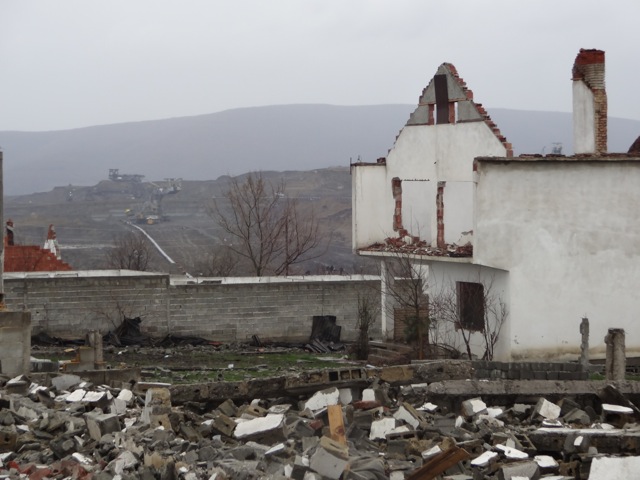
The expansion of a coal mine ends the life of a Kosovo village. Photo by Ted Downing 2013.
INDR President Ted Downing appointed a talented committee, an Ad Hoc Committee on Mining and Sustainable Development, to critically review the draft protocol. On 11 April 2013, the INDR Committee presented their preliminary findings to Luke Danielson, a member of the Mining Law Committee and their revised version will be published shortly on this page.
Learn more about mining and forced displacement:
Avoiding New Poverty: Mining-induced displacement and resettlement. Theodore Downing 2002. London: International Institute for Environment and Development.
Mining and Indigenous Peoples: Stakeholder Strategies and Tactics. Indigenous Peoples and Mining. Theodore Downing, Carmen Garcia-Downing, Jerry Moles and Ian McIntosh. 2003 IN Finding Common Ground:Indigenous Peoples and their Association with the Mining Sector. World Business Council for Sustainable Development and the International Institute for Environment and Development (UK). P. 11-46.
Last Updated (Monday, 8 April 2013)